In deep-sea drilling platforms and ultra deep well onshore drilling rigs, the mud circulation system is the "lifeline" that maintains wellbore stability, carries rock debris, and cools the drill bit. The flexible conveying pipe connecting the mud pump and the riser must maintain zero leakage under extreme conditions of high displacement and high pulse. The large-diameter design with an inner diameter of 6 inches directly serves the demand for high flow transportation - as the well depth increases, the annular pressure consumption sharply rises, and only by expanding the pipe diameter can sufficient displacement be maintained to carry rock debris. The ample margin of 2.5 times the working pressure for blasting pressure provides a sufficient safety margin for the frequent occurrence of instantaneous overpressure on the drilling site.
News
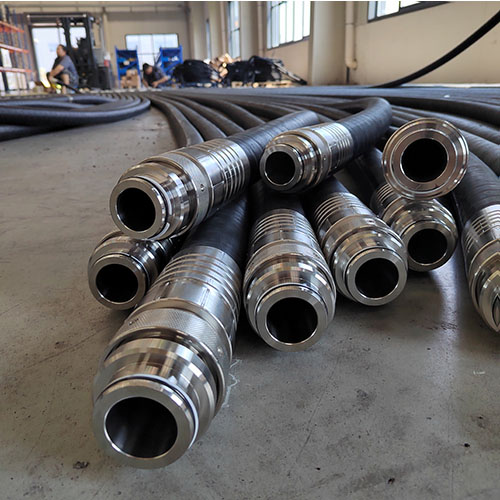
API 7K large-diameter mud conveying pipe with an inner diameter of 6 inches and a burst pressure of
1、 2.5 times blasting allowance: API 7K D-grade 5000psi "safety password"
The API 7K standard divides the working pressure of rotary drilling hoses into multiple levels, including A level (1500psi) to G level (20000psi), among which D level (5000psi) is the standard configuration for mid to deep drilling operations, covering the mud pumping needs of most onshore and offshore drilling platforms. The verification pressure for D-grade hoses is 7500psi (1.5 times the working pressure), and the minimum burst pressure is 12500psi, which is 2.5 times the working pressure.
The design safety factor of 2.5 times is not arbitrarily set - according to the theory of thin-walled pressure vessels, the failure modes of hoses under extreme pressure include various forms such as "wire layer fracture", "interlayer peeling", and "joint detachment". The API 7K standard quantifies the design margin through blasting testing, ensuring that even if the system pressure suddenly jumps due to abnormal conditions such as mud pump failure or well surge closure, the hose can still maintain structural integrity. For the reinforcement layer of 4-6 layers of high-strength and ultra flexible steel wire spiral winding, a margin of 2.5 times means that the blasting pressure far exceeds the maximum pressure that the system may actually experience, providing ample safety protection for on-site operators.
2、 6-inch caliber: Deep sea high displacement 'flow artery'
A caliber of 6 inches (approximately 152mm) is considered the upper limit of large caliber in the API 7K hose system. According to the specifications, the outer diameter of the 6-inch D-grade 5000psi hose is 196mm, the minimum bending radius is 1600mm, and the weight per unit length is approximately 33kg/m.
The flow significance of this design is very significant - the pipeline transport capacity is proportional to the square of the diameter, and the flow area of a 6-inch pipeline is 2.25 times that of a 4-inch pipeline. In deepwater drilling, the mud return velocity needs to reach a critical value (usually about 0.6-1.2m/s) to effectively carry rock debris back up. After using a 6-inch conveying pipe, the system displacement can be increased from approximately 2.0m ³/min for a 4-inch pipe to over 4.5m ³/min without increasing pump pressure, significantly reducing the risk of downhole accidents such as rock debris settling and drill jamming caused by insufficient displacement.
The structural challenges posed by large-diameter hoses cannot be ignored. As the diameter of the pipe increases, the circumferential stress corresponding to the blasting pressure increases linearly. The reinforcement layer of API 7K 6-inch hose is addressed by increasing the number of wire layers (4-6 layers) and optimizing the winding angle - the inner wire provides radial support to resist tube bulging, while the outer wire bears axial load to prevent excessive elongation of the hose under pulse pressure.
3、 Deep sea adaptation: from riser connection to blowout preventer assembly
The API 7K 6-inch large-diameter mud conveying pipe has two core application scenarios in drilling systems. One is the flexible connection between the upper end of the riser and the top drive/rotating device: the top drive moves up and down with the drilling tool and generates continuous relative displacement with the riser fixed to the wellhead. The 6-inch hose serves as a "flexible joint" that absorbs displacement energy through the elastic deformation of multi-layer reinforced structures, protecting the riser and top drive from abnormal stress damage. The second is the flexible connection between the mud pump and the lower end of the riser: the reciprocating motion of the mud pump generates intense pressure pulses, and the 6-inch hose acts as a "shock absorber" here, absorbing pump end vibrations and buffering pressure pulsations.
In terms of installation adaptation for offshore drilling platforms, 6-inch large-diameter hoses are mainly matched with 6-inch Fig1003/1002 hammer joint or integral flange. The joint adopts a structure of metal to metal hard sealing combined with O-ring auxiliary sealing, which maintains zero leakage under high pressure and pulse impact of 5000psi. Due to the large weight per unit length, it is necessary to reasonably configure support brackets and pipe clamps during deck installation to prevent additional bending stress caused by the sagging of hoses due to their own weight. In severe sea conditions such as typhoons, the FSL2 flexibility level design of API 7K hoses can effectively absorb the displacement caused by ship swaying, ensuring uninterrupted mud circulation during storms.
In terms of material selection, 6-inch API 7K hoses provide layered adaptation solutions for different types of mud media. When transporting oil-based mud with high oil content, HNBR (hydrogenated nitrile rubber) lining can be used, which has better oil swelling resistance than ordinary rubber under high temperature and high pressure; When transporting deep well mud with high sand content and strong abrasion resistance, UPE (ultra-high molecular weight polyethylene) lining can be used, which has a wear resistance 6-7 times higher than ordinary rubber. The precise matching of lining material and medium type can significantly extend the service life of hoses in acidic media (including H ₂ S) or high abrasion conditions.
In summary, the API 7K large-diameter mud conveying pipe with a 6-inch inner diameter and a burst pressure of 2.5 times the working pressure perfectly meets the systematic requirements of "high displacement, high safety, and dynamic reliability" for deep-sea drilling and ultra deep well operations with its D-class 5000psi standard bearing capacity, mechanical redundancy reinforced by 4-6 layers of steel wire, and six inch diameter high flow adaptability. From 12500psi blasting redundancy to 1600mm bending radius design, from material grading of HNBR/UPE lining to quick connection of Fig1003 union, every technical parameter points to the same goal: to provide a reliable flexible channel that can withstand pressure impact and medium erosion for high-pressure mud transportation in the roar of drilling rigs at depths of thousands of meters.