
At mining, oil fields, and infrastructure construction sites near the Arctic Circle, the Siberian ice sheet, and the high-altitude regions of Northeast China, winter temperatures can drop sharply below -40 ℃. When the equipment is parked overnight in extreme cold and restarted, the viscosity of the hydraulic oil suddenly increases, and ordinary hoses become brittle and hard like glass. The pressure shock at the moment of pump start-up often directly leads to pipeline cracking - this is the common phenomenon of "cold start pipe bursting" in equipment maintenance in cold regions. The -40 ℃ low-temperature hydraulic oil pipe is a professional solution for this working condition - it uses a special cold resistant rubber formula to achieve molecular level flexibility at -40 ℃, avoids cold start damage with system level preheating specifications, and provides "performance redundancy" for extreme environments with ultra-low temperature selection of -50 ℃ or even -57 ℃, becoming a reliable guarantee for construction machinery in cold regions to "start and work" in the harsh winter.
News
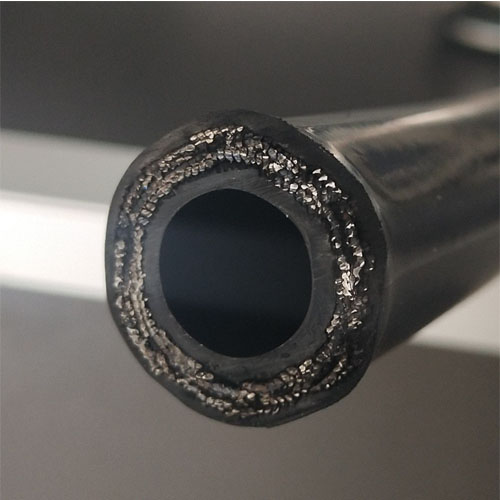
Low temperature resistant hydraulic oil pipe -40 ℃ maintains flexibility and ensures worry free cold
1、 Molecular Code at -40 ℃: The Scientific Boundary of Low Temperature Elasticity and Glass Transition
The failure of rubber at low temperatures is rooted in the "freezing" of molecular chain segment motion. When the temperature drops below the glass transition temperature (Tg) of the material, the activity of the originally flexible polymer segments is limited, and the material transitions from a high elastic state to a brittle glass state, which may crack even with slight bending. In engineering, -40 ℃ is a critical boundary point - the Tg of standard nitrile rubber is about -40 ℃, which is the fundamental reason for the failure of ordinary hoses in extreme cold.
The -40 ℃ low-temperature resistant hose has broken through this limit through a dedicated cold resistant nitrile rubber formula. By selecting main rubber materials with excellent cold resistance and combining them with special plasticizers (such as DOS instead of ordinary DOP), the Tg of rubber can be effectively reduced, and the molecular chain movement ability can be maintained at -40 ℃ to avoid entering a brittle state. Transfer Oil's 147-CPLT 3600 NEO thermoplastic hose uses a polyester elastomer inner tube and a special low-temperature outer adhesive layer, suitable for hydraulic systems such as forklifts, maintaining a "high degree of flexibility" in the temperature range of -55 ℃ to+100 ℃.
Low temperature deflection test is the core detection method for verifying the reliability of hoses at -40 ℃. This test simulates extreme low temperature environments to evaluate the structural integrity and sealing reliability of hoses subjected to bending deformation at specific low temperatures. The tested product has no cracking in its inner and outer adhesive layers, and can still withstand the verification pressure without leakage after returning to room temperature.
2、 The engineering logic of cold start: flexible guarantee from "hard start" to "soft start"
The danger of cold starting equipment in cold regions is not only due to the brittleness of the hoses themselves. At low temperatures, the viscosity of hydraulic oil increases sharply, the suction resistance of the pump increases significantly, and the damping of the return oil pipeline increases, resulting in an increase in return oil pressure. If starting directly at full load at this time, the viscous force between the plunger and the cylinder body may be too large, which may widen the clearance between the plunger sliding shoes (normally 0.02-0.03mm, exceeding 0.15mm may cause a sudden drop in pressure or even plunger pull-out accidents).
The value of low-temperature resistant hoses in this scenario is reflected in two dimensions:
Firstly, the pulse carrying at the moment of activation. -At 40 ℃, the hose has been left to stand at low temperature for several hours, and the low-temperature elasticity of its inner adhesive layer ensures that it can still maintain sealing under the initial pressure impact of pump start-up. Even if the viscosity of the oil causes high starting pressure in the pipeline, the hose will not fail due to brittle fracture.
Secondly, the buffering effect of preheating protection. In industry practice, before starting equipment in cold regions, the hydraulic system needs to be preheated - using low pour point synthetic hydraulic oil and equipped with an oil preheating system to raise the oil temperature to the allowable working range. Low temperature resistant hoses will not experience interlayer peeling or external adhesive cracking due to alternating cold and hot during the preheating process, providing a pipeline side coordination guarantee for "soft start".
3、 System selection: Performance redundancy from -40 ℃ to -57 ℃
For routine operations in cold regions (around -40 ℃), low-temperature resistant hydraulic oil pipes that meet the rated temperature of -40 ℃ are sufficient to meet the requirements. In environments with drastic temperature fluctuations, such as when transported to a warm warehouse for maintenance and exposed to severe cold again, plasticizers or low-temperature flexible additives may precipitate from the rubber, leading to a subsequent decrease in low-temperature performance. Therefore, choosing products that have undergone a complete low-temperature cycle test is more reliable.
For more extreme working conditions such as the Arctic Circle and Antarctic scientific expeditions (-50 ℃ to -60 ℃), it is necessary to choose solutions with lower Tg or materials that already have excellent low-temperature performance. The Continental Arctic series can withstand -58 ° F (-50 ° C); Eaton Ice Champion and Gates PolarFlex achieve an ultra-low temperature rating of -70 ° F (-57 ℃), reinforced with four to six layers of spiral steel wire. Dongjin brand low-temperature resistant rubber pipes are made of nitrile rubber material, which can maintain flexibility at -55 ℃ and work pressure up to 38MPa.
When selecting, it should be noted that the temperature rating of the hose is the continuous operating temperature rather than the instantaneous withstand temperature. Even for ultra-low temperature models, preheating should still be carried out according to operating specifications when used below -40 ℃ - hoses still have a certain degree of molecular chain movement ability at -57 ℃, but the viscosity of hydraulic oil has significantly increased, the pump suction load has increased, and pressure fluctuations in the pipeline may exceed the actual dynamic bearing capacity of the hose at that temperature.
In summary, the molecular level flexibility of the dedicated cold resistant rubber formula, structural verification of the -40 ℃ low-temperature bending test, and performance redundancy of the -57 ℃ ultra-low temperature selection of the -40 ℃ low-temperature hydraulic oil pipe perfectly meet the systematic needs of cold engineering machinery for "no pipe explosion during cold start, no brittleness during extreme cold, and worry free system operation". The wide range selection from -40 ℃ to -57 ℃, and the multi material scheme from NBR to TPU and PA11, every optimization of molecular chain movement and upgrade of material selection all point to the same goal: to provide reliable and impact resistant guarantees for the cold start of construction machinery in the harsh cold winds of Siberia and the extreme low temperatures of the Arctic Circle.