
In oil and gas drilling well control operations, the hydraulic control system of the blowout preventer (BOP) is the last line of defense to prevent blowouts. The fire-resistant rubber hose connecting the control device and the blowout preventer group not only needs to withstand ultra-high pressure pulses under normal working conditions, but also needs to maintain structural integrity in the event of a sudden fire. The traditional single-layer woven structure is prone to failure of the reinforcement layer due to stress concentration under the dual tests of high pressure and fire, becoming a weak link in well control safety. The BOP fire-resistant rubber hose with double-layer steel wire weaving reinforcement layer is a reinforcement scheme for this extreme working condition - a "mesh skeleton" formed by interlocking two layers of high-strength steel wires to form a collaborative load-bearing structure, providing sufficient safety margin for pressure transients with explosive redundancy of 4 times the working pressure, and verifying the structural integrity under extreme working conditions through API 16D standard fire resistance testing. It has become a safety barrier for "high pressure does not burst, fire scene does not fail" in the hydraulic control system of the anti spray device.
News
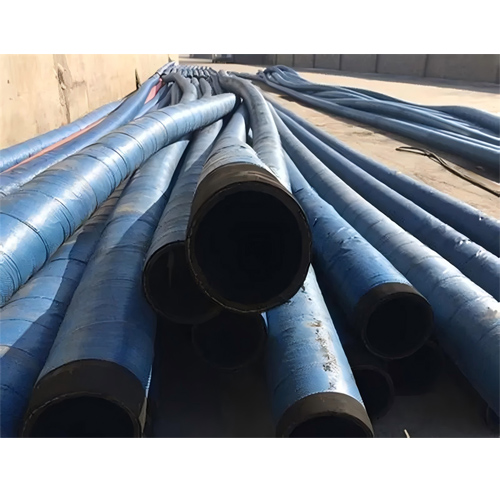
The double layered steel wire braided reinforcement layer of BOP fire-resistant rubber hose has a bu
1、 The structural logic of double-layer weaving: from "single-layer" to "double-layer" anti explosion crossing
The reinforcement layer of BOP refractory rubber hose is the core component that withstands the ultra-high pressure pulse of the well control system. Under continuous high-pressure impact, single-layer woven structures are prone to fatigue fracture at the intersection of steel wires due to concentrated stress distribution. The double-layer steel wire braided reinforcement layer upgrades the reinforcement structure from a "single-layer mesh" to a "double-layer interlocking skeleton" by adding a layer of high-strength steel wire braided layer.
Two layers of steel wire are not simply stacked, but formed into a "mesh skeleton" structure through precise weaving in alternating directions. When the rubber hose is subjected to internal pressure, the two layers of steel wires cooperate to constrain the radial expansion of the pipe body, while sharing the axial tensile load - the inner layer weaving mainly resists bulging deformation, and the outer layer weaving suppresses excessive elongation, so that the stress is evenly distributed between the two layers of steel wires, avoiding the local stress concentration that is prone to occur in single-layer structures under high pressure. The layers are firmly bonded by a high adhesive interlayer layer, ensuring that there is no interlayer slip or peeling under frequent pressure pulses.
The direct benefit of this structural design is a significant increase in blasting pressure. According to industry technical specifications, the burst pressure of BOP refractory rubber hoses can reach 3-4 times the working pressure. Taking the working pressure specification of 5000psi (approximately 35MPa) as an example, the minimum burst pressure reaches 15000psi (approximately 105MPa); The specification of 10000psi (approximately 70MPa) corresponds to a burst pressure of over 30000psi. The explosion redundancy, which is four times the working pressure, provides ample safety buffer for the possible instantaneous pressure peak in the event of a blowout emergency.
2、 Collaboration of Multi Layer Composite Structures: System Integration from Inner Layer Sealing to Outer Layer Fire Protection
The double-layer woven reinforced BOP fire-resistant rubber hose needs to withstand both ultra-high pressure pulses and high fire temperatures simultaneously, relying on the system integration of a multi-layer structure of "inner rubber layer reinforcement layer fire-resistant layer outer protective layer".
The inner rubber layer directly contacts hydraulic oil and drilling fluid, and is formulated with nitrile rubber (NBR) or hydrogenated nitrile rubber (HNBR). It can withstand hydraulic oil erosion within a temperature range of -29 ℃ to+121 ℃ without swelling or peeling. For acidic well conditions, the HNBR inner rubber layer also has excellent resistance to H ₂ S corrosion.
The reinforcement layer adopts a double-layer or multi-layer high-strength steel wire weaving structure. Some products can be configured with 2-8 layers of steel wire winding or weaving according to pressure level requirements to ensure high pressure pulse resistance performance. The reinforcing layer steel wire is treated with copper plating, which combines high tensile strength and good rubber adhesion.
The fire-resistant insulation layer is the key difference between BOP fire-resistant rubber hoses and ordinary high-pressure rubber hoses. Add composite refractory layers such as aluminum silicate fiber, flame-retardant rubber, or glass fiber cloth outside the inner layer and reinforcement layer. When burned with an open flame at 750 ℃ -1093 ℃, a dense carbonization layer is formed to isolate heat transfer to the reinforcement layer.
The outer protective layer adopts a flame-retardant and wear-resistant outer layer composed of chloroprene rubber or silicone rubber and aramid fiber. Some products are equipped with stainless steel armor protective layer. Even if the outer layer is burned in a fire, the armor can still maintain the shape of the pipe and prevent the reinforcement layer from being exposed.
3、 Well control scenario adaptation and full cycle management
The value of double-layer woven reinforced BOP fire-resistant rubber hoses in drilling well control systems ultimately depends on the full cycle guarantee of standard certification, installation specifications, and maintenance management.
Execution standards and certification are the primary basis for determining whether a product meets well control safety requirements. The product must pass the fire resistance test of API 16D standard - exposed to an open flame environment at 704 ℃ (1300 ° F) under rated working pressure for 5 minutes without leakage. High end products can work continuously in a 750 ℃ flame for 15-30 minutes or more. When purchasing, it is necessary to verify whether the product is labeled in accordance with API Spec 16D standard.
The installation specifications directly affect the safety redundancy of the double-layer braided structure. The bending radius should not be less than the rated value (such as a minimum bending radius of 280mm for 3/4 inch specifications) to avoid stress concentration in the weaving layer due to sharp bends. The end fittings are configured with NPT threads or integral compression joints to ensure that they do not loosen under high voltage pulses.
In terms of maintenance and management, BOP fire-resistant rubber hoses are critical safety equipment for well control. Each hose should record the production batch, fire resistance test data, and installation date. During daily inspections, it is important to observe whether the stainless steel armor is deformed and whether there is leakage at the joints. If any abnormalities are found, they should be replaced immediately.
In summary, the BOP fire-resistant rubber hose with double-layer steel wire weaving reinforcement and a burst pressure of 4 times the working pressure perfectly meets the safety requirements of the hydraulic control system of the blowout preventer for "high pressure non explosion and fire scene non failure" with its double-layer staggered weaving collaborative load-bearing structure, 4 times the burst redundancy ultra-high pressure safety margin, and API 16D standard 704 ℃× 5-minute fire resistance verification. The structure leaps from single-layer to double-layer, and the fire-resistant upgrade from 5 minutes to 30 minutes. The design of each layer of steel wire weaving and fire-resistant insulation layer points towards the same goal: to provide reliable guarantees for the hydraulic control of the blowout preventer in extreme danger of explosion and fire, without bursting, leaking, or losing function.