In industrial scenarios such as chemical plants, mining slurry transportation, and dock oil loading and unloading, large-diameter hoses need to simultaneously cope with multiple challenges - medium corrosion, pressure fluctuations, negative pressure suction, and on-site mechanical wear. Traditional rubber inner pipes have limited lifespan in the presence of highly corrosive media, while pure plastic pipes lack flexibility. The combination of UPE (ultra-high molecular weight polyethylene) lining and multi-layer fabric winding reinforcement structure is the key solution to meet this demand - using UPE's chemical inertness to resist medium erosion, using a composite reinforcement structure of multi-layer fabric winding and spiral steel wire to bear pressure and negative pressure, and using EPDM outer layer to resist on-site environmental erosion, becoming a reliable channel for "pressure stability, corrosion resistance, and long life" in large-diameter industrial fluid transportation.
News
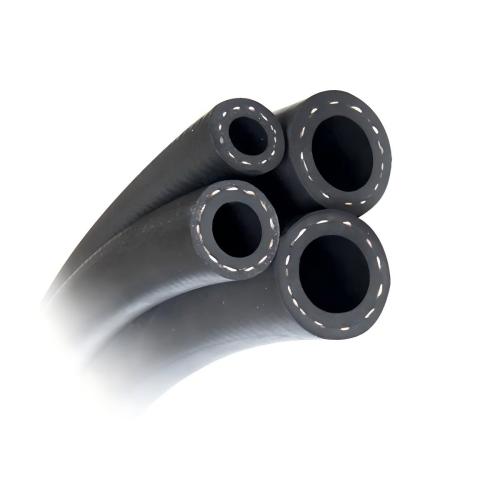
UPE industrial rubber hose with large diameter adopts multi-layer fabric winding to enhance pressure
1、 Chemical barrier of UPE lining and mechanical logic of multi-layer fabric reinforcement
Large caliber industrial rubber hoses need to maintain long-term reliability in high flow transportation, which cannot be achieved without the coordinated use of lining materials and reinforced structures. The molecular weight of UPE (ultra-high molecular weight polyethylene) typically reaches millions, and its carbon carbon saturated bond structure endows the material with excellent chemical inertness, making it resistant to corrosion by the vast majority of acids, bases, salts, and organic solvents. Meanwhile, its friction coefficient is much lower than that of ordinary rubber, with low conveying resistance and less prone to scaling.
The structural design of the reinforcement layer determines whether the hose can maintain dimensional stability under alternating positive and negative pressure conditions. Multi layer fabric winding reinforcement is the key to solving this problem - high-strength synthetic fibers are wound in multiple layers at specific angles to form the "mechanical skeleton" of the pipe body. On this basis, spiral steel wires are stacked to provide radial support to prevent the tube from bulging when subjected to positive pressure, and to maintain the cross-section of the tube from collapsing during negative pressure suction. Product data shows that the large-diameter UPE hose with this structure can achieve a burst pressure of 3-4 times the working pressure (such as working pressure of 16-17 bar, burst pressure of about 64-69 bar), and a vacuum pressure resistance of 0.9 bar.
2、 Large caliber specification coverage and pressure stability verification
The specification coverage of large-diameter industrial rubber hoses directly affects their applicability in scenarios such as chemical transportation, mining discharge, and dock loading and unloading. The inner diameter of the UPE multi-layer fabric wrapped rubber hose covers a wide range of 3/4 inch to 6 inches. The working pressure of products with different diameters remains consistent, and the burst pressure is uniformly 3-4 times the working pressure. This "same pressure level" design eliminates the need to recheck the safety factor due to changes in diameter during selection.
Large caliber specifications (such as 4 inches, 6 inches) maintain stable pressure bearing capacity in scenarios such as chemical slurry transportation and tailings discharge. The composite reinforcement structure of spiral steel wire and multi-layer fabric can still provide sufficient radial support and axial tensile strength under large diameters, ensuring the dimensional stability of the pipe body in pressure fluctuations caused by pump start stop and valve switching. The minimum bending radius for large-diameter hoses (such as 4-inch and 6-inch) is approximately 675mm and 800-900mm, respectively, which requires sufficient bending space to be reserved during installation.
3、 EPDM outer rubber and connection adaptation: system integration for on-site working conditions
The external protection of UPE multi-layer fabric wrapped rubber hoses is also worth paying attention to. The outer rubber layer is made of EPDM synthetic rubber, which is wear-resistant, ozone resistant, and resistant to atmospheric aging. It can effectively resist long-term outdoor exposure or erosion from salt spray air. Some products have conductive copper wires implanted on the outer layer, with surface resistance controlled at a low value, in compliance with EN12115 anti-static standards and ATEX explosion-proof certification requirements, suitable for flammable and explosive chemical environments. The cloth pattern design of the outer adhesive layer increases the on-site grip friction and facilitates operation.
In terms of end connections, large-diameter UPE hoses are usually equipped with flanges or threaded interfaces, which can achieve standardized docking with on-site pipeline systems. During installation, it should be noted that the bending radius should not be less than the rated value (such as about 800-900mm for a 6-inch specification) to avoid damage to the reinforcement layer due to excessive bending. During daily inspections, special attention should be paid to whether the outer adhesive layer is cracked, whether the joints are leaking, and whether the ends of the spiral steel wire are corroded and exposed. When deep cracks appear in the outer adhesive layer or the reinforcement layer is exposed, it should be replaced in a timely manner.
In summary, the large-diameter industrial rubber hose with UPE lining and multi-layer fabric winding reinforcement structure perfectly meets the systematic requirements of "corrosion resistance, pressure stability, and long service life" in chemical, mining, and dock scenarios, thanks to its three core technologies: chemical inert barrier of UPE material, composite reinforcement skeleton of multi-layer fabric and spiral steel wire, weather resistance protection of EPDM outer rubber, and wide caliber coverage. From a working pressure of 17 bar to a burst redundancy of 64 bar, adapting to a wide temperature range from -35 ℃ to 100 ℃, covering specifications from 3/4 inch to 6 inches, each layer of fabric winding and each spiral steel wire design is aimed at the same goal: providing reliable guarantees of non corrosion, non suction, and non failure for corrosive media and high flow conditions on large-diameter industrial fluid transmission lines.