In deepwater oil and gas extraction, subsea production systems utilize a complex fluid transport network comprising Christmas trees, manifolds, and jumpers. The jumper hoses connecting this subsea equipment must operate reliably over the long term at depths of several thousand meters and working pressures of 232 bar, while simultaneously withstanding seawater corrosion, ocean currents, and dynamic loads caused by platform displacement. API 17K bonded jumper hoses offer an engineered solution for these extreme conditions: an integrally vulcanized bonded structure withstands the 232 bar pressure; UPE/PTFE liners resist corrosion from the conveyed media; and stainless steel armor provides protection against seawater erosion. Together, these features create a reliable, flexible conduit—embodying the principle of "flexibility over rigidity"—within deepwater production systems.
News
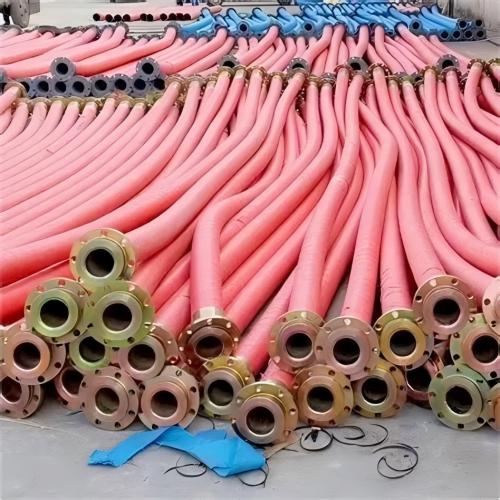
Oil drilling and production hose; bonded deep-sea jumper hose; working pressure 232 bar; seawater co
I. Mechanical Logic of 232 bar Working Pressure and Bonded Structures
A working pressure of 232 bar (approximately 3365 psi) represents a typical medium-to-high pressure rating for subsea jumper hoses, accommodating the transport of various media such as crude oil, natural gas, injection water, and chemical agents. According to API 17K specifications, a 3-inch bonded jumper hose has a working pressure of 232 bar, a test pressure of 348 bar (1.5 times the working pressure), and a minimum burst pressure of 580 bar (2.5 times the working pressure). This three-tiered pressure gradient—working, test, and burst—provides ample safety margins against the pressure fluctuations and transient overpressure events that can occur in deepwater operations.
The core technology enabling these jumper hoses to replace traditional steel piping lies in their integrally vulcanized bonded structure. Unlike unbonded hoses, where individual layers can slide relative to one another, API 17K bonded hoses utilize a vulcanization process to fuse the inner rubber layer, reinforcement layer, and outer rubber layer into a chemically cross-linked, unified whole. The reinforcement layer employs a composite design featuring polyester fiber braiding combined with high-strength, ultra-flexible copper-plated steel wire. When the subsea production system is subjected to bending loads caused by platform displacement or ocean currents, the bonded structure ensures the uniform transfer of bending, tensile, and torsional loads across the various layers. This prevents the premature fatigue failure often caused by interlayer slippage in unbonded structures. This characteristic is particularly critical for deepwater jumpers, which connect two subsea components prone to relative displacement; the hose must accommodate this movement through its own elastic deformation without creating stress concentrations.
II. A Dual Barrier Against Seawater Corrosion and Fluid Incompatibility
Deepwater environments expose hoses to corrosive forces from both the outside and the inside: externally, through continuous seawater immersion and salt spray penetration; and internally, through acidic oil and gas fluids containing H₂S and CO₂. API 17K bonded jumper hoses utilize a multi-layer composite structure to establish a comprehensive protection system.
The inner liner serves as the first line of defense against fluid corrosion, utilizing UPE (Ultra-High Molecular Weight Polyethylene) or PTFE materials with a thickness of up to 4.0 mm. UPE offers wear resistance 4 to 7 times greater than that of conventional steel and withstands long-term exposure to H₂S, CO₂, and acidic fluids; PTFE is renowned for its extremely low coefficient of friction (0.05–0.10), making it ideal for transporting high-viscosity crude oil or fluids prone to scaling. The reinforcement layer employs a composite structure of synthetic rubber, polyester fiber braiding, and high-strength, ultra-flexible copper-plated steel wire, enabling the hose to withstand internal pressures of 232 bar while maintaining necessary flexibility. The outer cover consists of wear-resistant, weather-resistant synthetic rubber—with an optional stainless steel armor layer—to withstand seawater immersion and external mechanical damage. The API 17K standard explicitly covers "sweet and sour production services," setting clear requirements for material performance in H₂S-containing environments. III. Subsea Production System Compatibility: The Engineering Value of Flexibility over Rigidity
The value of API 17K bonded jumper hoses in subsea production systems lies primarily in the advantages they offer as alternatives to traditional steel pipe solutions.
Regarding dynamic load adaptation, the bonded structure allows the hose to absorb axial tension and bending deformation caused by platform motion and the relative displacement of subsea equipment. Unlike rigid steel pipes, these hoses can accommodate dynamic displacements induced by waves and currents through elastic deformation while withstanding internal pressures of 232 bar; this prevents fatigue cracking at rigid connection points caused by stress concentration. The API 17K standard specifies fatigue design criteria for hoses used in dynamic applications, requiring consideration of combined bending, tension, and torsion loads.
In terms of installation efficiency, the modular design of bonded jumper hoses significantly reduces the time required for subsea connection operations. Standard products can reach lengths of up to 77 meters; a 3-inch hose weighs approximately 4 kg/m in seawater and—equipped with integral union or flange connectors—allows for rapid connection via ROV (Remotely Operated Vehicle). Domestically produced API 17K jumper hoses have seen large-scale deployment in fields such as Wenchang 13-2, where they withstood the extreme conditions of a Category 17 super typhoon, maintaining seal integrity even when platform displacement reached 2.8 meters.
Regarding design life, the API 17K standard mandates that hoses pass type tests—including hydrostatic pressure, tensile, bending stiffness, and impulse fatigue tests—and specifies a Design Fatigue Factor (DFF) of 10, consistent with riser systems classified under the "High" safety level. These rigorous design criteria ensure that bonded jumper hoses maintain structural integrity throughout a design life exceeding 20 years. In summary, the API 17K deep-sea bonded jumper hose—rated for a working pressure of 232 bar—perfectly meets the systematic requirements of deep-sea oil and gas development for high-pressure resistance, corrosion resistance, and dynamic reliability. It achieves this through three core technologies: an integrated vulcanized bonded structure capable of withstanding 232 bar and adapting to dynamic loads; a dual corrosion-resistant barrier comprising a UPE/PTFE liner and stainless steel armor; and a design that replaces rigid steel piping with a flexible alternative compatible with subsea production systems. From a 580-bar burst pressure safety margin and a wear-resistant 4.0 mm thick liner to an operating temperature range of -30°C to 100°C and seal integrity verified under typhoon conditions, every aspect of the bonded structure and liner design serves a single goal: to provide a reliable, flexible conduit—resistant to corrosion, leakage, and fatigue—for subsea production systems operating in the dark depths of the ocean.