
In environments such as the transport of corrosive fluids in chemical industrial parks, the transfer of acidic or alkaline media in wastewater treatment plants, or pickling processes in the metallurgical industry, conventional rubber hoses often fail rapidly when exposed to such substances. Issues like the swelling and degradation of the inner liner, or the corrosion and fracture of the reinforcement layer, not only create safety risks—such as the leakage of corrosive media—but also lead to high maintenance costs and production downtime due to the frequent need for hose replacement. Fabric-reinforced, acid-and-alkali-resistant EPDM rubber hoses leverage the inherent corrosion resistance of EPDM material and a high-strength, fabric-reinforced structural design. They provide a long-lasting protective barrier against various acidic and alkaline media, offering a highly reliable piping solution for the transport of corrosive fluids under low-to-medium pressure.
News
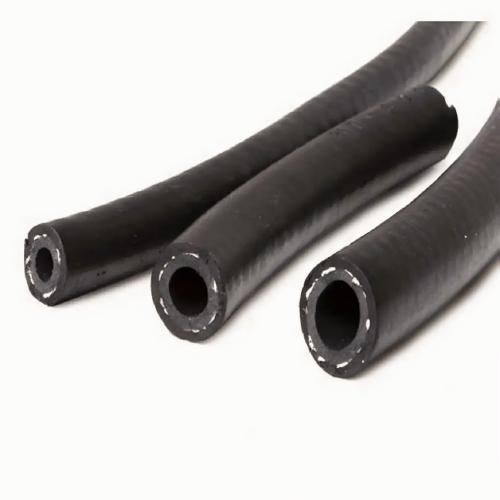
Fabric-reinforced EPDM rubber hose resistant to acid and alkali corrosion
EPDM’s saturated molecular backbone inherently meets the requirements for resistance to a wide range of acid and alkali concentrations.
The molecular chains of conventional rubber contain numerous unsaturated double bonds. Highly corrosive substances—such as strong acids and bases—can readily engage in oxidation or addition reactions with these double bonds, rapidly cleaving the polymer chains. This causes the otherwise highly elastic rubber to quickly harden, become brittle, swell, and disintegrate, rendering it incapable of long-term, stable service in acidic or alkaline environments. In contrast, the molecular backbone of EPDM (ethylene propylene diene monomer) rubber consists of a fully saturated alkane structure. It lacks the unsaturated, reactive sites susceptible to attack by acid or alkali molecules, thereby blocking—at the material level—the chemical pathways through which corrosive media would otherwise degrade the polymer chains.
EPDM rubber exhibits exceptional resistance to a variety of polar acidic and alkaline media. It can withstand long-term exposure to substances such as sulfuric acid (at concentrations up to 40%) and sodium hydroxide (at concentrations up to 30%), as well as the vast majority of inorganic acids and weak alkaline solutions, without undergoing significant molecular chain degradation. Empirical data shows that after thousands of hours of continuous immersion in a 40% sulfuric acid solution at 80°C, EPDM rubber retains over 85% of its tensile strength, with a mass change of less than 5%. Its service life in acidic or alkaline environments is 6 to 10 times that of standard natural rubber, making it well-suited for the vast majority of low-to-medium pressure applications involving the transport of corrosive fluids.
Furthermore, EPDM exhibits exceptional temperature resistance, with a maximum continuous operating temperature of up to 120°C. This makes it ideal for transporting heated acidic or alkaline media in chemical processing and wastewater treatment—environments where the performance of conventional corrosion-resistant rubber would otherwise rapidly degrade. Even under specific conditions involving intermittent contact with strong oxidizing acids or bases, EPDM rubber—when enhanced with specialized corrosion-resistant formulations—maintains stable physical properties without premature failure. This inherent material advantage, which cannot be replicated in ordinary rubber through simple modification, serves as the fundamental basis for the hose’s long-term resistance to acid and alkali corrosion.
A multi-layer fabric-reinforced composite structure balances corrosion resistance with mechanical pressure-bearing strength.
A hose made solely of EPDM rubber has limited pressure-bearing capacity, making it suitable only for very low-pressure fluid transport—insufficient for the pressurized requirements of most industrial applications. This fabric-reinforced, corrosion-resistant EPDM hose utilizes a composite design featuring multiple layers of rubber-impregnated fabric. This structure preserves the superior acid and alkali resistance of EPDM while significantly enhancing the hose’s overall pressure-bearing capacity and mechanical strength, effectively integrating corrosion resistance with robust mechanical performance.
The inner lining—the layer in direct contact with acidic or alkaline media—consists of thickened, high-purity EPDM rubber, formed via a seamless, integrated vulcanization process. The lining is entirely free of bubbles, pinholes, or other localized defects, effectively eliminating the risk of corrosive media penetrating the inner structure through weak points. The thickness of the inner lining is optimized based on the concentration and temperature of the specific acid or alkaline media, with an ample corrosion allowance incorporated to ensure that the lining is not rapidly corroded or breached during long-term exposure to corrosive substances. Furthermore, the EPDM lining features a highly dense surface, which effectively inhibits the penetration of acid or alkaline molecules and further slows the ingress of corrosive media toward the pipe wall.
The intermediate reinforcement layer consists of multiple plies of high-strength, rubber-dipped fabric—pre-treated with a styrene-butadiene rubber (SBR) compound—applied in a balanced, crisscross winding pattern. The number of plies, ranging from two to six, is tailored to the hose's nominal diameter and rated working pressure. This design significantly enhances both the longitudinal tensile strength and the overall pressure-bearing capacity of the hose; the finished product boasts a burst pressure exceeding four times its rated working pressure, providing a substantial safety margin. Because the pre-treated fabric reinforcement is fully encapsulated in rubber compound, corrosive media cannot penetrate through the gaps between fibers via capillary action, thereby preventing the common issue where corrosive substances spread rapidly along the fabric layers and compromise the internal structure.
The outermost cover layer is also composed of a modified, weather-resistant, and acid/alkali-resistant EPDM rubber. This ensures that the exterior does not suffer from rapid chalking or cracking when exposed to corrosive vapors or salt spray in chemical processing environments, providing a robust protective barrier for the internal reinforcement layers and preventing external corrosive agents from attacking the structural framework. All rubber layers within this composite structure are formulated from the same corrosion-resistant rubber system and are bonded at the molecular level through a co-vulcanization process. This ensures the structural integrity of the entire assembly, preventing delamination or blistering—even during long-term exposure to acidic or alkaline environments. For specialized applications requiring negative-pressure suction, a helical steel wire reinforcement can be embedded into the structure; this effectively prevents the hose from collapsing or flattening during suction operations, further broadening the range of environments in which the hose can be utilized. Purpose-built for diverse industrial applications, delivering comprehensive cost reduction and efficiency gains throughout the entire product lifecycle.
In sectors such as chemical processing, wastewater treatment, and metallurgy—where corrosive fluids are frequently transported—the need for constant replacement of standard corrosion-resistant hoses has long been a major pain point for operators, driving up procurement costs and causing costly operational downtime. This fabric-reinforced, acid- and alkali-resistant EPDM rubber hose offers a service life far exceeding that of conventional alternatives, enabling users to achieve significant, long-term cost savings and operational efficiency.
In small-to-medium-sized chemical industrial parks, where acid and alkali materials are often transported via temporary piping, standard corrosion-resistant hoses typically require complete replacement every six to twelve months. This not only incurs substantial procurement expenses but also interrupts the flow of corrosive substances, disrupting the continuity of the entire production line. By switching to this fabric-reinforced EPDM hose, the service life can be extended to over five years—drastically reducing replacement frequency and eliminating production losses caused by unplanned downtime. In municipal wastewater treatment plants—specifically for the transport of acidic or alkaline wastewater and the handling of chemical dosing agents—this hose excels due to its superior corrosion resistance. Unlike standard PVC hoses, which tend to age and crack rapidly, this EPDM hose significantly lowers the risk of leaks and mitigates environmental hazards associated with the potential release of corrosive wastewater.
In the metallurgical industry, during acid-pickling processes, hoses are frequently exposed to heated acidic solutions. The high-temperature and corrosion-resistant EPDM material is perfectly suited to these demanding conditions; it remains stable and avoids the rapid swelling and failure common in ordinary rubber hoses, thereby substantially extending the replacement interval for pickling-line piping. The hose assembly can be customized to meet the specific requirements of various applications, with options for different bore sizes, pressure ratings, and connection types. Large-bore versions can be fitted with flanges, facilitating the long-distance transport of high-volume, corrosive fluids. Smaller-bore versions can be equipped with quick-connect couplings, offering the flexibility needed for temporary chemical dosing or material transfer tasks. Additionally, anti-static variants are available for scenarios involving flammable, explosive, or corrosive media that require static electricity mitigation.
During routine maintenance, the condition of the hose can be quickly assessed through a simple visual and tactile inspection. Checking the surface for noticeable swelling, bulging, or cracking—and ensuring the material retains good elasticity when pressed—confirms that the rubber remains in sound condition. If the hose wall becomes noticeably hard or brittle and develops extensive surface cracking, it indicates that the EPDM material is beginning to degrade due to corrosion; at this point, a replacement can be scheduled. This straightforward approach eliminates the need for complex testing procedures, significantly enhancing operational safety when handling corrosive substances. For industrial users who frequently transport low-to-medium concentration acidic or alkaline media, this fabric-reinforced, acid-and-alkali-resistant EPDM rubber hose offers a dual advantage: it substantially lowers annual procurement costs while reducing the safety and environmental risks associated with unexpected leaks. It serves as a durable, reliable barrier for the transport of corrosive fluids in various low-to-medium pressure applications.