
In shipbuilding and repair—whether on open-air slipways or inside enclosed ship compartments—compressed air serves as the primary power source for a wide range of handheld pneumatic tools, including grinders, paint spray guns, and impact wrenches. DN19 air hoses, which connect mobile air sources to these tools, are subjected to the harsh, demanding conditions of a shipyard: high salt-mist exposure, intense ultraviolet radiation, and the constant threat of flying weld spatter. Standard industrial air hoses often degrade within just a few months, suffering from salt-induced aging of the outer cover or localized heat damage. Such deterioration not only reduces the performance of pneumatic tools but also creates serious safety risks, including high-pressure air leaks or hose ruptures. Our DN19 fabric-reinforced, heat-resistant, low-pressure air hose is specifically engineered for these unique shipyard environments. It offers a highly reliable, flexible piping solution tailored to the rigorous demands of shipbuilding and repair operations.
News
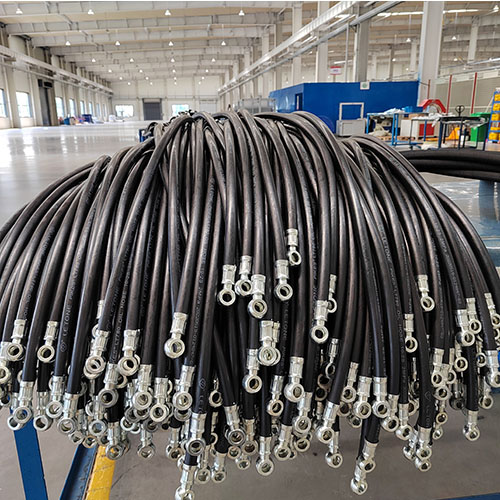
DN19 Fabric-Reinforced Heat-Resistant Low-Pressure Air Conveyance Hose for Shipyards
High-Density Fabric Reinforcement, Precision-Engineered for Shipyard Low-Pressure Pneumatic Systems
Most standard DN19 industrial air hoses utilize a basic, low-tension braiding process, resulting in a loose arrangement of reinforcement fibers and poor pressure stability. In a shipyard—where hoses are frequently dragged across surfaces or stepped on—these products are prone to localized bulging and deformation, making them unsuitable for long-term use in such complex working environments. This specialized DN19 shipyard air hose features a high-density, interwoven polyester fabric reinforcement structure. It has been mechanically optimized for the typical low-pressure pneumatic systems found in shipyards (operating between 0.6 MPa and 1.0 MPa), ensuring stable pressure resistance and exceptional resistance to deformation within its DN19 diameter. The DN19 bore size is precisely engineered to meet the compressed air flow requirements of the vast majority of handheld pneumatic tools used in shipyards. This design strikes an optimal balance: it avoids an excessively large bore—which would make the hose cumbersome and burdensome for workers to drag during operation—while also preventing an undersized bore, which would otherwise cause a sharp increase in flow resistance and a subsequent loss of power at the pneumatic tool. Empirical data shows that at a standard operating pressure of 0.8 MPa, this DN19 hose experiences a pressure drop of only 0.05 MPa per 100 meters. This ensures that compressed air can be delivered effectively across the typical working radius of a shipyard (spanning several tens of meters), maintaining consistent power output at the tool without significant degradation over distance.
The high-density reinforcement layer consists of high-strength polyester filament fabric, applied via a multi-layer, balanced-angle winding process. The tension of each fabric layer is precisely calibrated using CNC equipment, ensuring uniform wall thickness throughout the DN19 hose with no localized weak points. The finished hose boasts a burst pressure consistently exceeding 3.0 MPa—more than three times the standard 0.8 MPa operating pressure—providing a substantial safety margin that easily withstands transient pressure fluctuations within the shipyard’s pneumatic system, thereby eliminating the risk of sudden hose bursts. Furthermore, this high-density reinforced structure offers exceptional resistance to stretching and crushing; even when frequently dragged or stepped on by workers on the slipway, the hose retains its shape without flattening or becoming obstructed. The DN19 flow cross-section remains fully intact, ensuring a smooth and stable supply of compressed air. The fabric layers are completely encapsulated within the rubber matrix, leaving no exposed fibers. This effectively blocks the capillary penetration of salt spray through the gaps between fibers, preventing the interlayer corrosion and delamination—common issues in standard braided hoses—that would otherwise occur in high-salinity, salt-spray-heavy environments. Material System Engineered for Shipyard Conditions: Enhanced Resistance to Salt Spray, Heat, and Aging
Standard industrial air hoses are not designed for the unique demands of a shipyard environment. In highly saline, marine-like conditions, their outer layers rapidly age and pulverize; furthermore, they are easily punctured by flying weld spatter, rendering them unsuitable for long-term, reliable service in shipbuilding and repair. This DN19 air hose, developed specifically for shipyards, features a material composition—from the inner liner to the outer cover—engineered to withstand complex shipyard conditions, offering a comprehensive upgrade in resistance to salt spray, heat, and environmental aging.
The inner liner, which comes into direct contact with compressed air, utilizes a specialized synthetic rubber formulation with high airtightness. Optimized through a unique manufacturing process, the liner’s dense structure ensures a significantly lower air permeation rate compared to standard hoses. This prevents gradual pressure loss during prolonged pressurized operation, thereby substantially reducing the energy consumed by shipyard air compressors during idle or low-load cycles. Additionally, the inner liner is designed to withstand the heated air discharged by shipyard compressors; even with long-term exposure to 80°C airflow, it remains resistant to swelling or the shedding of rubber debris. This prevents loose rubber particles from clogging the precision air passages in pneumatic tools—such as grinders and paint spray guns—ultimately extending the service life of the end-use pneumatic equipment.
The outer cover employs a modified blend of EPDM (ethylene propylene diene monomer) and SBR (styrene-butadiene rubber), enhanced for salt spray, heat, and abrasion resistance. Specially formulated with salt-spray-resistant additives, the cover resists corrosion, pulverization, and cracking caused by chloride ions in the harsh, saline, open-air environment of a shipyard. Furthermore, the inclusion of heat-resistant components ensures that the hose can withstand brief contact with high-temperature weld spatter, preventing extensive burn-through and significantly improving durability during "hot work" operations. The outer cover has also been reinforced for superior abrasion resistance, ensuring it can withstand prolonged dragging and friction against rough steel plates and concrete slipways without wearing through prematurely. The outer rubber layer is formulated with a blend of UV absorbers and anti-ozonants, preventing rapid cracking or aging—even when exposed to the intense UV radiation and high ozone levels typical of outdoor shipyard slipways. The hose retains its elasticity and flexibility, even after long-term outdoor use. Through a high-temperature continuous vulcanization process, all rubber layers are fused at the molecular level; this ensures the integrity of the composite structure, preventing delamination, separation, or blistering, even in the high-humidity, high-temperature-fluctuation environments common in shipyards. The hose’s flexibility has been specifically optimized to maintain excellent bending performance across a wide temperature range (-30°C to 70°C). It remains pliable—never hardening or becoming brittle—even in cold, outdoor winter conditions. This allows workers to easily bend and drag the hose across the slipway without the snagging or resistance often associated with stiffer hoses, significantly enhancing operational convenience on-site.
Designed for diverse shipyard environments, this hose reduces costs and boosts efficiency throughout its entire service life, while ensuring safety during shipbuilding and repair operations.
In shipbuilding and repair, the frequent replacement of standard air hoses—and the resulting procurement costs and operational downtime—has long been a major pain point for shipyards. This DN19 fabric-reinforced, heat-resistant air hose, designed specifically for shipyard use, offers a service life far exceeding that of standard industrial air hoses, delivering comprehensive cost savings and efficiency gains over its entire lifecycle.
In outdoor slipway operations, such as pneumatic grinding and rust removal, standard industrial air hoses often fail within 1–2 months due to salt-spray aging and abrasion from being dragged. This not only incurs high replacement costs but also leads to unexpected hose failures that interrupt work, potentially delaying the overall project schedule. By switching to this DN19 shipyard-specific air hose, the service life is extended to over two years. This drastically reduces the frequency of replacements and eliminates the project delays caused by unplanned, hose-related operational stoppages. In applications such as spray painting or pneumatic assembly within enclosed ship compartments, hoses are frequently bent and dragged through tight spaces. Their exceptional flexibility ensures smooth handling without snagging or resistance, significantly boosting operational efficiency inside the vessel.
For outdoor repair operations at shipyards, hoses are often exposed to coastal environments with high salt-mist levels. The salt-mist-resistant outer cover prevents premature aging, eliminating the need for frequent replacements and greatly easing the burden of hose maintenance. These hoses can be customized to meet specific shipyard requirements, including tailored lengths and connector configurations. They can be pre-fitted with standard pneumatic quick-connect couplings, allowing for immediate integration with portable air sources and pneumatic tools upon delivery—eliminating the need for on-site assembly and substantially reducing installation labor. Furthermore, anti-static versions are available for use in explosion-proof zones, ensuring enhanced safety in specialized, high-risk environments.
During routine maintenance, the condition of a hose can be quickly assessed through simple visual inspection—checking for signs of wear (such as exposed reinforcement), heat damage, blistering, or age-related cracking. This straightforward approach eliminates the need for complex testing procedures, simplifying the management of pneumatic piping systems. For shipbuilding and repair enterprises, adopting these DN19 fabric-reinforced, heat-resistant, low-pressure air hoses not only lowers annual procurement costs but also mitigates the risks of sudden hose failure—preventing safety hazards and operational downtime. They provide a highly reliable solution for the transmission of compressed air, ensuring the stable performance of various handheld pneumatic tools throughout the shipyard.