
In large-scale construction sites and metallurgical forging workshops—where high-pressure air is distributed via temporary piping networks—10-inch large-bore air hoses serve as the critical conduits for high-volume, high-pressure air. These hoses must endure extreme, continuous operating conditions, including constant pressurization, the dragging of heavy objects, exposure to high-temperature radiant heat, and high levels of dust. Conventional, small-diameter, spliced air-line systems are not only inefficient to install but are also prone to leaks at joints and localized ruptures during long-term operation. Such failures can lead to a widespread loss of power for pneumatic equipment downstream and pose severe safety risks—such as high-pressure air jets capable of causing serious injury—while the resulting unplanned downtime often incurs production losses far exceeding the cost of the hose itself. Designed specifically for high-volume, high-pressure air transport, this 10-inch industrial air hose features an optimized structure and material composition, ensuring stable pressure resistance and high reliability—providing an efficient, flexible solution for air delivery in construction and metallurgical forging environments.
News
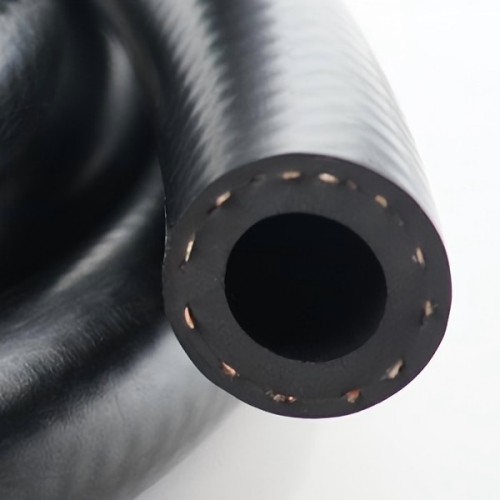
Large-diameter 10-inch air-conveying rubber hose for construction, metallurgy, and forging applicati
Multi-layer fabric-reinforced composite structure: uniform pressure distribution and deformation resistance for 10-inch large-bore hoses
Most standard large-bore air hoses rely on simple, single-layer fabric reinforcement, which results in highly uneven stress distribution across the hose wall. Under large-bore conditions, this frequently leads to localized bulging or wall deformation—making them entirely unsuitable for the long-term, pressurized demands of construction and metallurgical forging operations. This 10-inch industrial air hose utilizes a reinforced structure consisting of multiple layers of high-strength, rubber-impregnated polyester fabric, applied via a crisscross composite winding process. Through the use of fluid dynamics simulation, the arrangement parameters for each fabric layer have been precisely optimized, ensuring uniform stress distribution across the entire hose wall and eliminating any localized weak points under pressure. Featuring a 10-inch large-bore design, this hose is perfectly suited for the centralized transport of high-pressure air at high flow rates. A single hose can deliver hundreds of cubic meters of air per hour—sufficient to supply dozens of pneumatic tools on a construction site or multiple pneumatic machines in a metallurgical forging workshop simultaneously. This eliminates the need for complex, multi-line parallel piping systems, significantly reducing both the installation effort and the costs associated with deploying high-capacity air distribution networks. Empirical data shows that at a standard operating pressure of 1.0 MPa, the pressure drop is only 0.03 MPa per 100 meters. This minimal pressure decay ensures that all pneumatic equipment—even those located far from the source—receives a stable and ample supply of high-pressure air, preventing any significant loss of power at the point of use.
The hose is constructed with multiple layers of high-strength, rubber-impregnated polyester fabric, wrapped at precisely calculated, alternating angles. Using computer-controlled (CNC) large-bore winding equipment, the angle and tension of each layer are calibrated with high accuracy, ensuring a uniform wall thickness throughout. This eliminates weak points that might otherwise arise from uneven fabric layering or inconsistent tension. The finished hose boasts a burst pressure exceeding 4.0 MPa—four times its standard 1.0 MPa operating pressure—providing a substantial safety margin. It is robust enough to withstand transient pressure surges and water hammer effects common in air compressor clusters at construction sites or metallurgical forging facilities, effectively preventing catastrophic pipe bursts. Furthermore, the multi-layer composite fabric reinforcement offers exceptional resistance to negative pressure and deformation; the hose will not collapse or flatten even when subjected to brief periods of suction, ensuring the large-bore cross-section remains fully open and preventing any airflow obstructions caused by structural deformation. Every fabric reinforcement layer is completely impregnated and encapsulated in rubber compound, effectively blocking any capillary pathways for high-pressure air to seep through the gaps between fibers. This eliminates the widespread "slow air leakage" common in standard large-bore hoses after prolonged pressurized operation, thereby significantly reducing energy consumption during the no-load (idling) phases of air compressor stations.
A material system engineered for diverse operational environments, offering comprehensive resistance to heat, abrasion, and weathering.
Standard large-bore air hoses are typically designed for simple water-transfer applications; they are ill-suited for the complex, multi-environment demands of construction sites—characterized by outdoor exposure, high dust levels, and frequent dragging—or metallurgical forging workshops, where hoses are subjected to intense radiant heat. In such settings, conventional hoses suffer from rapid aging and damage to their outer layers. This 10-inch large-bore air hose features a material system specifically modified—from the inner liner to the outer cover—to meet the distinct requirements of these demanding environments, delivering a significant upgrade in heat, abrasion, and weather resistance.
The inner liner, which comes into direct contact with high-pressure compressed air, utilizes a specialized synthetic rubber formulation with superior airtightness. Through a proprietary optimization process, the density of the liner is enhanced, ensuring that the permeation rate of high-pressure air is far lower than that of standard large-bore water hoses. Consequently, the hose maintains its integrity even during long-term operation at 1.0 MPa, with no noticeable gradual pressure loss. Furthermore, the inner liner is engineered to withstand 100°C compressed air—a typical output temperature from air compressor stations—preventing rapid swelling or the shedding of rubber debris. This ensures that no rubber particles enter downstream pneumatic equipment, which could otherwise cause blockages in precision air circuits or jamming of pneumatic valves. As a result, the replacement cycle for vulnerable components in large-scale pneumatic equipment—such as those found in metallurgical forging workshops—is substantially extended. The outer cover is composed of a specialized rubber blend engineered for high abrasion resistance, heat resistance, and weatherability. It is reinforced with high-abrasion-resistant carbon black and short aramid fibers, resulting in an abrasion rate only one-third that of standard large-diameter water-conveyance hoses. This ensures that the hose can withstand prolonged dragging and friction against rough, gravel-strewn surfaces or steel plates at construction sites without the outer cover wearing through prematurely. For high-temperature environments—such as those found in metallurgical forging workshops—the outer cover incorporates heat-shielding additives. These provide protection against intense thermal radiation from forging equipment and prevent the cover from sustaining extensive burn-through or damage upon brief contact with hot, flying iron-oxide scale. Furthermore, the outer cover contains a synergistic blend of UV absorbers and anti-ozonants, which prevent cracking, aging, or chalking when exposed to the high-UV conditions of outdoor construction sites, allowing the hose to retain its elasticity even after long-term outdoor use.
All rubber layers of the large-diameter hose undergo continuous high-temperature vulcanization in a large horizontal autoclave, achieving molecular-level bonding. This ensures the structural integrity of the composite assembly, preventing delamination or blistering—even when subjected to the extreme temperature fluctuations of outdoor construction sites or the high-dust environments of metallurgical forging facilities. The overall flexibility of the hose has been specifically optimized; even with a large 10-inch diameter, it can achieve a tight bending radius. This allows for on-site deployment without the need for heavy lifting equipment, significantly simplifying the installation of large-diameter piping systems. Optimized for Key Industrial Applications: Reducing Costs and Boosting Efficiency Across the Entire Lifecycle of High-Volume Air Distribution Networks
In large-scale construction projects and metallurgical forging operations—environments that demand the transport of high-volume, high-pressure air—traditional solutions like segmented metal ductwork or parallel small-diameter piping have long been plagued by high installation costs, frequent leaks, and complex maintenance. This 10-inch large-bore industrial air hose addresses these challenges. With its high flow capacity, exceptional reliability, and ease of deployment, it delivers comprehensive cost savings and efficiency gains throughout its entire service life.
On large-scale outdoor construction sites, setting up high-volume, high-pressure air networks using conventional segmented metal ductwork is time-consuming—often taking days to install—and prone to leaks at the numerous flanged joints. Furthermore, relocating such piping requires labor-intensive disassembly and reassembly. By contrast, this 10-inch large-bore air hose allows for rapid deployment: a single, continuous length (spanning tens of meters) can be laid out and connected via flanges at either end. This reduces installation time by over 90%, virtually eliminates intermediate leak points, and significantly lowers both initial installation costs and the burden of ongoing leak-related maintenance. Moreover, the hose can be easily repositioned as construction progresses, eliminating the need for repeated dismantling and reassembly, thereby greatly enhancing the operational efficiency of pneumatic equipment on-site.
In metallurgical forging workshops, where high-pressure air is distributed from a central compressor station to forging machinery, this 10-inch large-bore air hose serves as a flexible connection. It absorbs the significant displacement stress caused by the thermal expansion and contraction of rigid metal piping—preventing cracks in welded joints that often occur over time due to vibration. Designed to withstand the high-temperature radiant heat and heavy dust typical of forging environments, the hose offers a service life far exceeding that of standard metal bellows expansion joints, substantially easing the maintenance requirements for high-pressure air networks in these facilities. Each hose assembly can be equipped with appropriately sized, large-bore flanges tailored to specific operational needs; upon delivery, they can be connected directly to existing standard piping flanges without the need for complex, additional port machining. For specialized environments requiring anti-static properties, a fully anti-static modified version can be custom-engineered. This variant is perfectly suited for use in explosion-hazard zones—such as those found in metallurgical workshops—thereby further enhancing operational safety in demanding settings.
During routine maintenance, the condition of the hose can be quickly assessed simply by inspecting the outer layer for visible signs of wear (such as exposed fabric), localized bulging, cracking, or aging. This eliminates the need for complex diagnostic procedures, significantly simplifying the management and maintenance of large-diameter, high-pressure air piping networks. For large-scale construction projects and metallurgical forging enterprises, adopting this 10-inch, large-diameter industrial air-conveyance hose offers substantial benefits: it drastically reduces both the initial installation costs and the annual maintenance expenses for high-volume air distribution systems. Furthermore, it effectively eliminates the safety risks and production downtime—often caused by frequent leaks or pipe bursts in conventional piping—providing a highly reliable, flexible solution for the centralized transport of high-volume, high-pressure air.