
In scenarios such as the long-distance inter-zone transfer of corrosive media within chemical industrial parks, the unloading of hazardous chemical tanker trucks, or the transport of corrosive slurries in mining operations, hoses are frequently subjected to complex conditions involving accidental dragging, stretching, and bending. Standard chemical hoses—typically reinforced with only a single layer of fiber—lack sufficient tensile strength; even minor external pulling can cause excessive elongation of the hose wall, delamination of the inner liner, or even complete rupture. A large-scale leak of highly corrosive media not only results in significant material loss but can also trigger major safety incidents, such as chemical burns or environmental contamination, posing extreme risks to on-site operations. In contrast, high-toughness, tensile-resistant chemical hoses—engineered with a multi-layer, interwoven high-strength fiber reinforcement and a high-toughness composite system—offer superior tensile strength and impact resistance. These hoses provide a highly reliable, flexible piping solution for chemical transfer applications that involve frequent movement or exposure to external pulling forces.
News
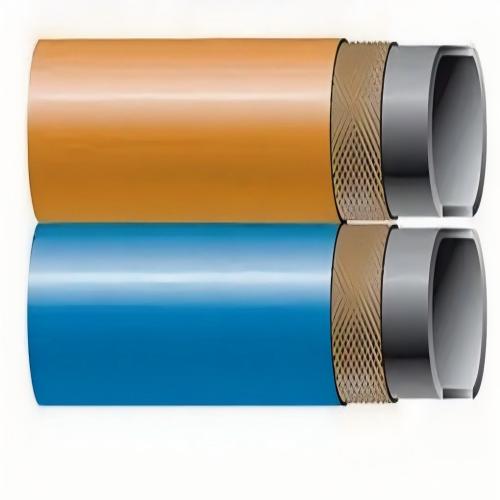
Multi-layer fiber-reinforced chemical hose with high tensile strength and high toughness
Multi-layer, Interwoven High-Strength Fiber Structure for Significantly Enhanced Tensile Performance
Most conventional chemical hoses utilize a single-layer fiber reinforcement, which offers very low overall tensile strength. During operation, accidental dragging or pulling can easily lead to excessive wall elongation or the rupture of the reinforcement layer, rendering the entire hose unusable. This high-toughness, tensile-resistant chemical hose features multiple layers of ultra-high-strength industrial synthetic fibers, arranged at precisely balanced, interwoven angles. Through mechanical simulation, the braiding density, tension, and orientation of each fiber layer are optimized so that the layers complement one another under stress. Consequently, the overall tensile strength of the hose far exceeds that of standard, single-layer reinforced chemical hoses of the same diameter. The reinforcement layer utilizes ultra-high-strength industrial polyester fibers, which possess a single-filament strength far exceeding that of standard nylon. During the manufacturing process, the braiding tension of each fiber layer is precisely calibrated by high-precision, numerically controlled (NC) braiding equipment, ensuring that tension deviations are kept to an absolute minimum. The fibers are arranged in an interleaved, multi-layered pattern; when the hose is subjected to axial tensile force, these layers distribute the load uniformly. This prevents localized overloading and subsequent breakage of individual fibers. Empirical data shows that, for a given nominal diameter, this multi-layer fiber-braided hose offers an ultimate tensile strength three to four times greater than that of conventional single-layer braided chemical hoses. Under external pulling forces, the axial elongation of the hose wall remains below 3%, preventing the significant stretching and subsequent flattening or reduction of the internal diameter—common issues with standard hoses—thereby ensuring the hose consistently maintains its full flow capacity.
A highly elastic rubber buffer layer is positioned between adjacent fiber-braided layers. This serves two purposes: it prevents wear and breakage caused by friction between fiber layers during stretching, and it acts as a stress-distribution layer, rapidly dispersing localized tensile forces across all fibers within the hose wall. This prevents mass fiber failure resulting from concentrated stress. The multi-layer fiber-braided structure has undergone tens of thousands of extreme tensile tests; even when subjected to twice its rated working tensile load, the hose wall remains intact, with no fiber breakage or delamination. In the event of an accidental pull or tug during field operations, the hose is protected against catastrophic rupture, providing a critical safety buffer for personnel to respond.
Thanks to the lightweight nature of the high-strength, multi-layer fiber-braided construction, the hose weighs more than 60% less than steel-wire-braided hoses with equivalent pressure ratings. This significantly reduces the physical burden on workers when dragging or repositioning hoses at well sites or industrial facilities. A single operator can easily lay out or relocate long sections of hose, leading to a substantial increase in operational efficiency. Furthermore, the non-metallic fiber-braided structure eliminates the risk of corrosion or breakage associated with steel-wire reinforcement. Even if the outer layer of the hose sustains minor abrasion, the internal reinforcement layer remains protected from rapid corrosion-induced failure, thereby enhancing the hose's adaptability to complex operating environments.
A high-toughness, fully composite wall system with significantly strengthened impact resistance and flex-fatigue resistance.
Standard chemical hoses often lack a composite wall design optimized for high toughness; consequently, they are prone to liner cracking or delamination when subjected to heavy impacts or repeated bending—making them unsuitable for applications involving frequent movement or complex operating conditions. This multi-layer, fiber-braided, high-tensile, and high-toughness chemical hose utilizes specially formulated, high-toughness compounds throughout its entire structure—from the inner liner to the outer rubber cover. Integrated with a highly elastic transitional bonding layer, the entire wall system achieves superior resistance to both impact and flex-fatigue. It maintains structural integrity even under complex external forces, preventing localized cracking or leakage.
The inner liner, which comes into direct contact with corrosive media, is constructed from a high-toughness, chemically resistant rubber compound enhanced with specialized elastic toughening agents. This liner offers an elongation-at-break more than 60% greater than that of standard corrosion-resistant rubber. Should the hose undergo deformation due to external pulling or bending, the liner deforms elastically in tandem with the hose wall, avoiding the brittle cracking common in conventional liners and effectively preventing media leakage caused by mechanical stress. Depending on the specific corrosion-resistance requirements of the conveyed media, the hose can also be configured with upgraded high-toughness UPE or PTFE liners. These options provide exceptional corrosion resistance while maintaining sufficient impact toughness, ensuring the liner does not crack, fracture, or delaminate under external impact. The outer cover utilizes a modified EPDM rubber formulation characterized by high wear resistance and high toughness, enhanced with specialized additives for impact and tear resistance. Its tear strength far exceeds that of standard chemical hoses; it remains intact even when subjected to scraping by sharp, hard objects or impacts from heavy items, ensuring a continuous protective barrier that prevents external debris or corrosive splashes from penetrating the internal reinforcement layers. The weather resistance of the outer cover has also been optimized, allowing for long-term use in outdoor chemical industrial environments—characterized by intense UV exposure and fluctuating temperatures—without becoming brittle, cracking, or losing its inherent toughness.
The inter-layer bonding system employs a highly elastic, high-toughness adhesive, creating a molecular-level, flexible fusion between the inner liner, the multi-layer fiber reinforcement, and the outer cover. As the hose undergoes repeated bending and stretching, the layers deform elastically in unison, preventing the delamination or blistering often seen in standard hoses under stress. The entire high-toughness wall structure has withstood tens of thousands of fatigue-inducing bend cycles while remaining completely intact—showing no signs of liner cracking or inter-layer separation—making it ideally suited for demanding operational environments that require frequent movement and dragging.
Designed for safety and compliance across all scenarios, this solution reduces costs and enhances efficiency throughout the entire lifecycle in applications involving frequent hose movement.
In operations such as the transport of hazardous chemicals or mining slurries—where hoses are frequently moved or dragged—standard chemical hoses often suffer from poor tensile strength, leading to an extremely short service life; even minor external pulling forces can render them unusable. Frequent replacements not only drive up procurement costs, but sudden ruptures or leaks also pose severe safety and environmental risks. This multi-layer, fiber-reinforced chemical hose is engineered for high tensile strength and exceptional toughness. Its entire production process strictly adheres to industry standards for industrial chemical transfer hoses. Every individual hose undergoes rigorous hydrostatic pressure testing and ultimate tensile strength verification before leaving the factory, and each unit is supplied with a comprehensive performance test report—ensuring full compliance with the safety and site-entry requirements for sectors such as the chemical and mining industries.
In outdoor unloading operations for hazardous chemical tanker trucks, conventional single-layer reinforced hoses are prone to localized stretching and damage due to frequent dragging, resulting in a very short service life. Furthermore, accidental run-overs or excessive pulling by vehicles can cause the hose to rupture and leak, posing severe safety risks. By contrast, this multi-layer, fiber-reinforced, high-toughness hose offers significantly enhanced tensile and impact resistance. It remains intact even when subjected to accidental dragging or minor run-overs, extending its overall service life to more than three times that of standard single-layer hoses. This drastically reduces the frequency of hose replacements in high-mobility applications and eliminates the safety and environmental hazards associated with accidental leaks. In mining operations involving the transport of corrosive slurries—where hoses are frequently dragged across the ground or subjected to vibrations and tension from equipment—the high-toughness wall structure ensures long-term integrity, preventing localized cracking or leaks and substantially lowering maintenance costs in remote mining sites.
The hose assembly can be equipped with corrosion-resistant quick-connect couplings or flanges tailored to specific operational requirements. The connection between the coupling and the hose body utilizes a specialized, high-retention crimping design that complements the hose’s high tensile strength, ensuring that the hose will not detach from the coupling even under extreme pulling forces. For applications involving the transport of flammable or explosive organic solvents that require anti-static properties, the reinforcement layer can be integrated with specialized conductive fibers. This facilitates continuous static dissipation, effectively eliminating the risk of fire or explosion caused by the accumulation of static electricity. During routine operations, the condition of the hose can be quickly assessed by periodically inspecting the outer layer for visible tears, bulges, or localized leakage, and by conducting pressure testing in accordance with chemical safety standards. This approach fully satisfies the safety and maintenance requirements for mobile fluid transfer applications.
For users in sectors such as hazardous chemical logistics, mining and metallurgy, or fine chemical manufacturing, this multi-layer, fiber-reinforced, high-tensile, and highly resilient chemical hose offers significant advantages. It not only substantially reduces the annual costs associated with the frequent procurement and replacement of hoses in mobile transfer operations, but also eliminates the risk of accidental rupture and leakage—a common issue with standard hoses that lack sufficient tensile strength and resilience. It provides a highly reliable, robust, and flexible solution for the transport of corrosive fluids, even under complex operating conditions involving significant external mechanical stress.